Hydrilla vs. native eelgrass: how to tell them apart
Native eelgrass is fish habitat. Hydrilla is an invasive that smothers it. Here's how to identify what's in your water before you start treatment.

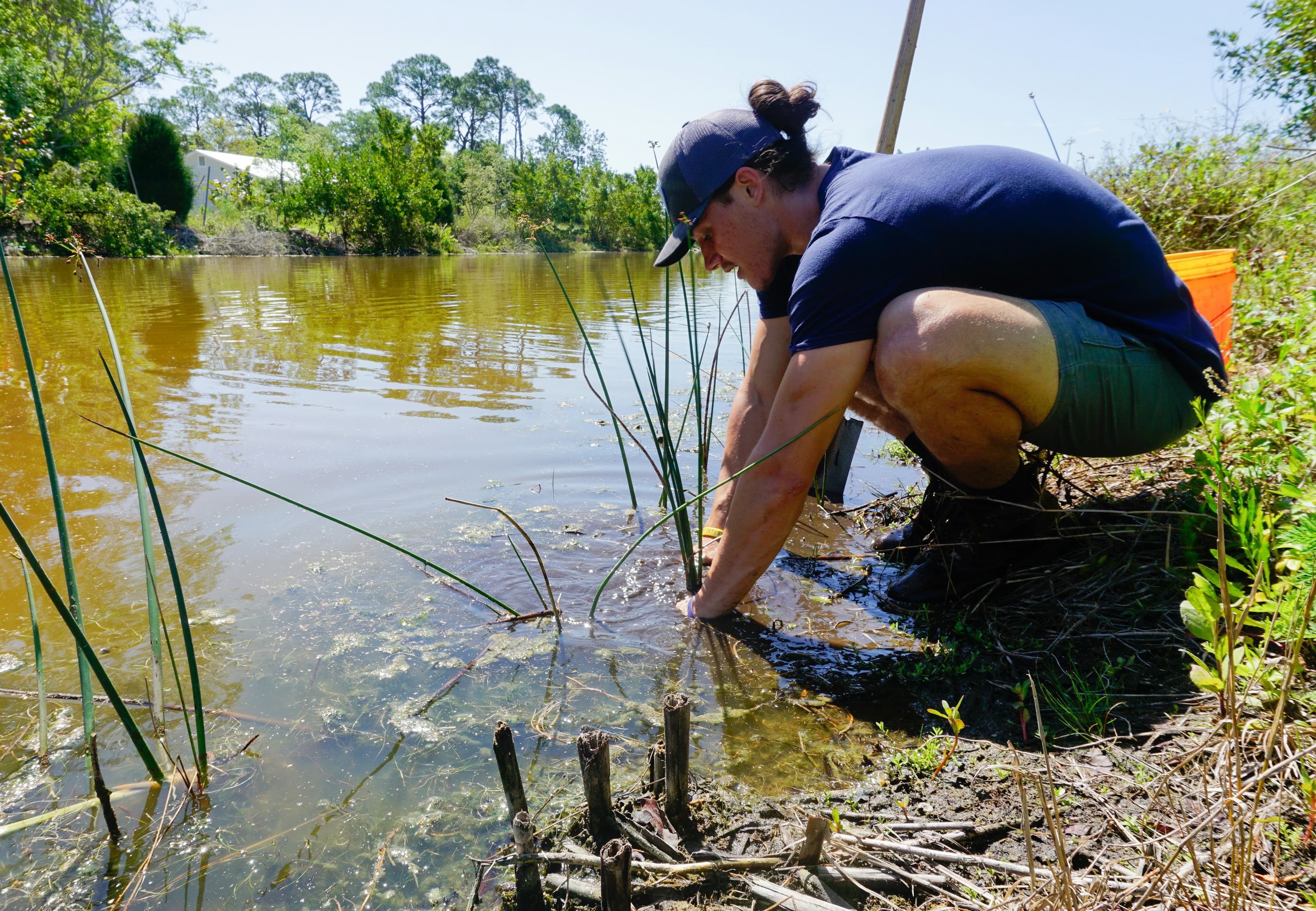
Before you treat any submerged vegetation, you need to identify it. Killing the natives leaves the door open for worse invasives.
Hydrilla identification
- Whorls of 3–8 leaves around the stem
- Tiny teeth along leaf edges — feels rough between your fingers
- Tubers and turions on the roots
- Brittle stems that snap and form new plants from fragments
- Tops out at the water surface in dense mats
Native eelgrass (Vallisneria americana)
- Flat ribbon-like leaves growing from the bottom in a rosette
- Smooth edges — slick between your fingers
- Grows toward the surface but does not form dense topped-out mats
- Critical fish habitat — largemouth bass, bluegill, and shiners spawn in it
Quick field test
Pull a sample from 3–4 ft of water. Count leaves per whorl. If you see whorls at all, it's hydrilla or Eurasian milfoil. Eelgrass grows from a single base point with no whorls.
Don't spray good grass
A broad-spectrum hydrilla treatment will kill eelgrass too. Mechanical removal lets you selectively harvest hydrilla while leaving native beds intact — and native beds are what stops the next invasive from establishing.
Frequently asked questions
What is the easiest way to identify hydrilla in a Florida lake?
Pull a stem from 3–4 ft of water. If you see whorls of 3 to 8 leaves spaced around a single stem with sandpaper-rough edges, it is almost certainly hydrilla. Native eelgrass has flat ribbon leaves growing from a single base, with smooth edges.
Will herbicide that kills hydrilla also kill eelgrass?
Most broad-spectrum hydrilla treatments (fluridone, endothall) damage or kill native eelgrass at typical application rates. Mechanical removal is the only method that selectively removes hydrilla while preserving native beds.
Why is eelgrass important?
Vallisneria americana (native eelgrass) is primary spawning and nursery habitat for largemouth bass, bluegill, and shiners. Losing eelgrass collapses the fishery long before anglers notice declining catch rates.
Founder of Aquatic Cleanup. Florida-licensed aquatic-vegetation operator working private lakes, HOA retention ponds, and waterfront properties across Volusia, Lake, Seminole, and Orange counties.
Related Articles

Shoreline restoration with native plants: a Florida buyer's guide
Mowed turf to the water's edge is the #1 cause of pond water quality problems. Replacing 6 ft with native shoreline plants fixes more than it looks.
 Mike
Mike
Preventing fish kills in Florida ponds: what actually causes them
Most Florida pond fish kills aren't poisoning. They're oxygen crashes — and they're predictable.
Mike
Lake Monroe aquatic vegetation: a homeowner's guide
Lake Monroe straddles Volusia and Seminole counties and carries decades of nutrient load from the upper St. Johns. Here's what to expect on the shoreline.
Mike
Filamentous algae in Florida ponds: why it keeps coming back
If your pond is clear in March and a green-mat disaster by June, the problem isn't the algae — it's the nutrient load.
Mike
Do I need a permit to remove aquatic plants from my Florida lake?
Florida's aquatic plant rules sit at the intersection of FWC, water management districts, and local code. Here's the practical version.
Mike
Cattail removal in Florida: when to manage and when to clear
Cattails are native, useful, and aggressive. Here's how to keep a healthy fringe without losing your shoreline to a 12-foot wall of vegetation.
Mike